With over 100 years of combined experience, our advisors understand the defeasance process from the inside out. We help property owners and brokers navigate the intricacies of commercial real estate loan exiting.
Real GDP is expected to grow approximately 1.8%-2.2% in 2026, reflecting a resilient but moderating economy.
Consumer spending continues to account for nearly two-thirds of U.S. GDP, supported by healthy household balance sheets.
Federal Reserve & Interest Rates
The Federal Reserve meets at the end of July, with markets seeing a 33% chance of a rate hike.
Markets broadly expect higher interest rates in 2026, likely two hikes, possibly starting in September or October
Inflation & Labor Market
CPI for June came in at 3.5% which is down from 4.2% in May – the first decline in annual inflation rate since January.
The unemployment rate remained at 4.2%, with 57,000 jobs added in June, reflecting a labor market that remains healthy but is gradually cooling.
Financial Markets
Equity markets remain near record highs, supported by continued AI-related investment and resilient corporate earnings despite higher-for-longer interest rates.
Investment-grade credit spreads remain near long-term averages, supporting continued liquidity across corporate and commercial real estate debt markets.
Commercial Real Estate Update
Capital Markets
Private-label CMBS issuance reached $70.3 billion through June 2026, an 18.1% increase from $59.3 billion during the same period in 2025, reflecting continued investor demand and improving capital markets.
CRE CLO issuance totaled $26.1 billion year-to-date, up 50.9% year-over-year, highlighting strong lending activity outside traditional conduit issuance.
Property Fundamentals
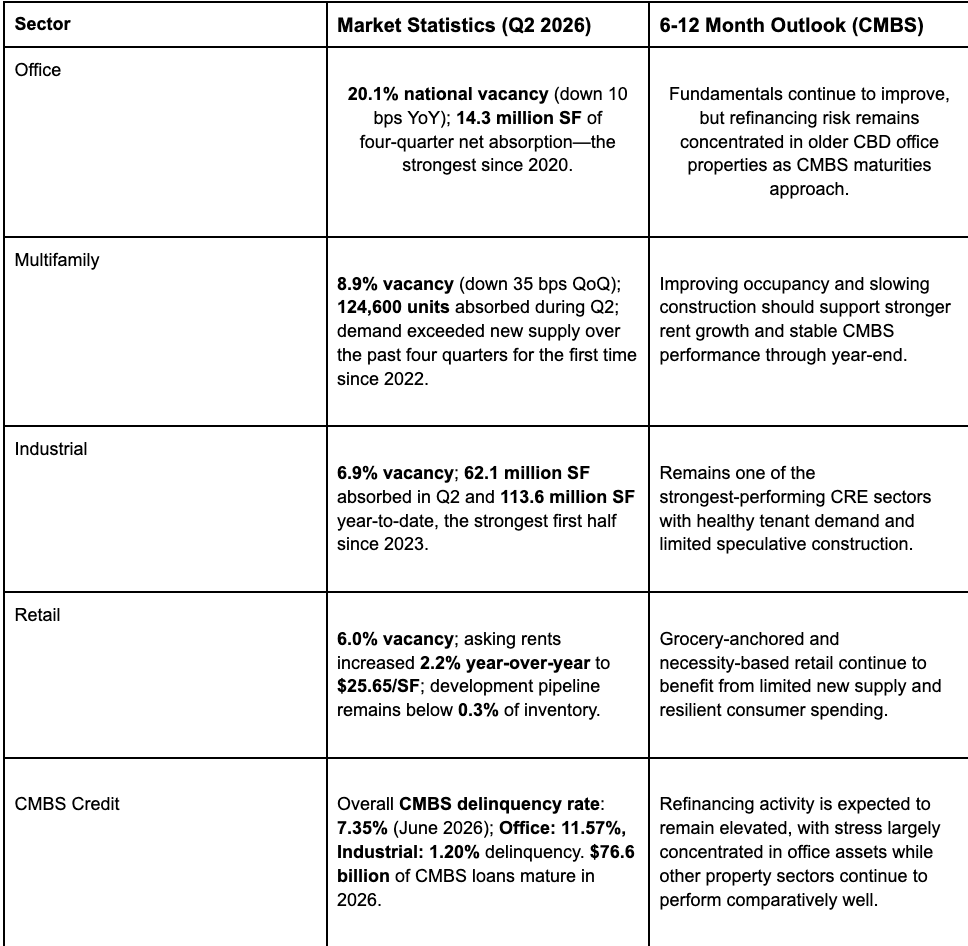
Office fundamentals continue to improve gradually, with national vacancy declining to 20.1%, the second consecutive year-over-year decline, while four-quarter net absorption reached 14.3 million square feet, the strongest level since 2020.
Industrial remains the strongest-performing major property type, with vacancy falling to 6.9% in Q2 2026 and year-to-date net absorption totaling 113.6 million square feet. Retail vacancy remains historically low at 6.0%, supported by limited new construction.
Debt Markets
Trepp’s overall CMBS delinquency rate declined to 7.35% in June, improving 20 basis points from May, largely due to the resolution of several large lodging loans.
Office remains the most stressed property type, with an 11.57% delinquency rate, while industrial continues to perform best at just 1.20%. Approximately $76.6 billion of CMBS hard maturities remain scheduled for 2026, with 39% maturing during the fourth quarter, keeping refinancing pressure elevated.
Outlook
Improving capital markets, higher CMBS issuance, declining delinquency rates, and strengthening leasing fundamentals suggest commercial real estate transaction activity should continue to build through the second half of 2026.
Refinancing risk remains concentrated in older office assets, while industrial, retail, and high-quality multifamily properties continue to benefit from healthy investor demand and improving credit conditions.
Defeasance Update
Activity Levels
Defeasance volume during the first half of 2026 is estimated to be 20%-30% above the same period in 2025 as refinancing activity accelerates.
Borrowers continue to capitalize on improved liquidity in both the CMBS and life company lending markets.
While long-term Treasury yields remain elevated, CMBS credit spreads have remained relatively stable, allowing borrowers greater certainty when evaluating refinancing and defeasance transactions. Trepp’s Chief Economist indicates that CRE credit conditions have generally stabilized compared with the volatility experienced in 2025.
The more stable rate environment is particularly important as $76.6 billion of CMBS loans mature in 2026, with 39% of those maturities occurring in the fourth quarter.
The maturity wall will continue to drive both refinancing and defeasance opportunities through the end of 2026.
Outlook
Assuming Treasury yields remain near current levels and CMBS issuance continues its recovery, industry participants expect defeasance volume to finish 2026 approximately 20%-30% above 2025, with activity remaining robust into 2027.